Published 16 January 2024
Royal Life Saving Australia is urging vigilance around water with more hot weekends to come, and says long term change requires a greater emphasis on upstream drowning prevention measures.
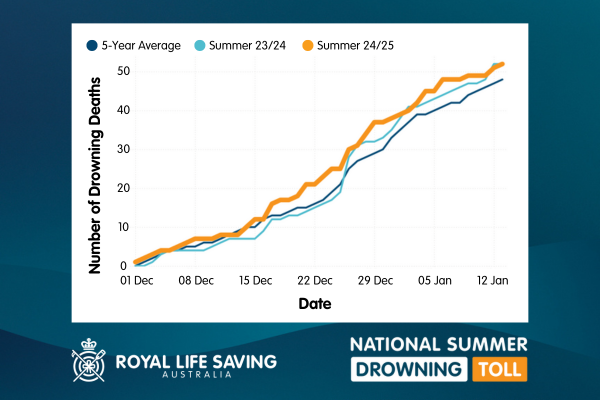
Halfway through summer, the Royal Life Saving Summer Drowning Toll shows that 60 people have fatally drowned across Australia since 1 December, more than one person per day.
Royal Life Saving fears Summer 2024/25 may exceed 110 deaths before the end of February, if this summer’s trend continues. A figure more than 10% higher than last year.
More than 14 people drowned between Christmas and New Year, and the first two weeks of January have been tragic with an average of one person drowning every day.
The highest number of drowning deaths have occurred in New South Wales (17), followed by Queensland (13), Victoria (12) and Western Australia. The highest numbers have been in regional areas (35), not cities. The Illawarra Shoalhaven in NSW has had five drowning deaths, and the Gold Coast, in QLD has had four. Drowning deaths have occurred at all types of aquatic locations, including in the home environment.
Tragically, seven children (≤17 years) have drowned this summer, and at least four people have drowned while attempting to rescue children in trouble in the water. In all cases, the children survived.
There have been many more hospitalisations. Royal Life Saving research shows that are three non-fatal drowning incidents for every fatal drowning (3:1). This ratio increases to 8:1 in children 0-4 years.
Royal Life Saving Chief Executive Officer Dr Justin Scarr said: “The tragic, underlying issue is that swimming rates are at historic lows. As a nation, I fear we’ve lost our herd immunity to drowning. Too few can swim. Too many seem to be willing to take risks by wading in the water, and quickly get into trouble when currents take them to deep water”.
The issue of declining swimming in children and adults has been flagged for years, but now needs urgent, coordinated action. The patchwork of measures implemented across Australia seems unlikely to reverse declining rates of swimming in children or adults, and that has grave consequences for everyone’s safety.
“Thousands of children, many now teenagers, missed lessons due to the pandemic, and increased migration, especially from nations where swimming is not common, means many adults can’t swim”,
Past summers have resulted in boosts to rescue services, including expanding lifesaving services and investments in new rescue equipment, but much more is needed upstream to reverse long term drowning trends.
Dr Justin Scarr said “The unfolding tragedy of this summer and last can’t be wasted. Significant investment in long term, upstream drowning prevention is needed. Royal Life Saving is calling for four things.
1/ Nationally co-ordinated investments to boost the swimming and lifesaving skills of children and young people, especially those aged 10-14 years who can’t yet swim 50m and float for 2mins.
2/ Large scale grant programs for refugee and migrant communities, delivered in local pools in partnership with community groups, to build swimming and water safety skills and aid in community cohesion.
3/ Expansion of Royal Life Saving’s approach to facilitating local water safety planning coordination, as outlined in the Australian Water Safety Strategy, so that communities affected by repeated drowning tragedies can unite to identify and implement localised, comprehensive and multisectoral solutions.
4/ Strategic, structured and long-term investment in building and refurbishing community swimming pools and learn to swim centres to meet the changing needs of communities in our growing cities and regional areas, and to ensure that those most likely to miss out have access to a safe place to swim.
“Recent announcements by the Prime Minister of funding for new and upgraded community swimming pools via the Growing Regions, Thriving Suburbs and Building Australia infrastructure funds are very much welcomed,” Dr Scarr said.
“Investment in community swimming pools has always been a key part of Australia’s approach to water safety and drowning prevention. More is needed to meet the medium-term impacts of ageing pools, changing community demographics, and growth in our mayor suburbs,” Dr Scarr said.
To stay safe around the water, make sure to:
- Always supervise children around water
- Avoid alcohol around water
- Wear a lifejacket when boating and fishing
- Know the conditions
- Avoid going alone
- Choose a patrolled beach and swim between the flags
Royal Life Saving’s Summer Drowning Toll dashboard is updated daily over the summer (1 Dec 2024 to 28 Feb 2025). This allows users to view timeline comparisons and several data variables by state.
Note that these are interim numbers, based on what it reported in the media only. We know that around 30 per cent of all drowning deaths go unreported over the summer period, especially those that occur in the home environment and among older people. Numbers will change with coronial investigations and the official number of summer drowning deaths will be reported in the 2025 National Drowning Report released in September.
For media enquiries, please contact Media Key on 0409 420 112 or 03 9769 6488
Royal Life Saving Society – Australia’s research, education and advocacy work in drowning prevention and water safety is supported by the Australian Government.